

Cutting Frames Faster for an Agricultural Equipment Manufacturer
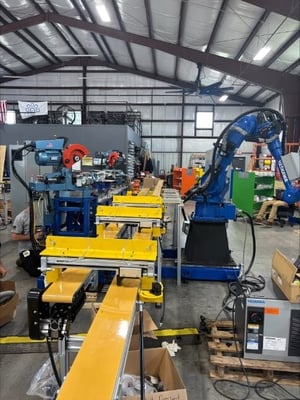 Industry: Agricultural and ranch equipment
Application: Robotic saw cutting of metal frames
Solution: (2) Yaskawa GP50’s with End of Arm tools
Integration Partner: JS Controls
An agricultural equipment manufacturer needed a way to hit an ambitious daily production target, and get it running fast, with only a couple of months to deploy. AFS partnered with JS Controls, the project's system integrator, to specify a pair of industrial robots equipped with custom end of arm tooling (EOAT).
AFS's role went beyond just supplying hardware. The team properly sized the robots, ran simulations to validate reach and cycle time, and designed and tested the EOAT before delivery, all within a compressed timeline. JS Controls brought critical engineering expertise to the table as well, developing key pieces of the solution that made the fast cycle time achievable.
Implementation Steps
- Built a robot simulation to verify reach and cycle time
- Used robot sizing software to confirm payload requirements
- Designed the end of arm tooling
- Verified the tooling through hands on testing
- Delivered the completed system to the customer
Engineering Highlights from JS Controls
A major engineering challenge on this project was tracking and clamping material accurately as it moved through the cutting process at high speed. JS Controls engineered a slip clamp mechanism paired with a linear encoder to solve this, allowing the system to maintain precise position tracking on the material while it was being fed and cut, without slowing down the line to do it.
To take that tracking a step further, JS Controls also introduced a new laser encoder tracking technology into the solution. This gave the system a more accurate, non contact way to monitor material position and feed rate in real time, improving overall cutting accuracy and helping the system reliably hit its throughput target. The encoder technology used in this tracking system was supplied by AFS's Encoder Products line, pairing precision sensing hardware with the mechanical design JS Controls built around it.
Why This Approach Worked
The project had two tightly linked requirements: a high daily throughput target running on a single robotic system, and a short window to get that system designed, built, and validated. Meeting both meant getting the fundamentals right the first time. Sizing the robot correctly up front avoided costly rework later, and designing the gripper around the actual part geometry, rather than a generic solution, was what made the fast deployment timeline realistic in the first place.
The slip clamp and linear encoder design, combined with the new laser tracking technology, solved the material handling piece of the puzzle, giving the robotic cutting system the positional accuracy it needed to run at full speed with confidence. Significant engineering time went into the gripper design alone, with additional dedicated time for testing and validation before the system ever reached the customer's floor. That upfront investment, paired with JS Controls' tracking solution, is what let the system go from design to production ready without surprises during installation.
Replication Potential
The successful deployment also opened the door to additional robot purchases from the same customer, a common pattern when a first system proves out the approach and builds confidence in both the technology and the team behind it. The tracking approach developed here, including the slip clamp, linear encoder, and laser tracking technology, also has clear potential for reuse in other high speed material handling applications.
Getting Started With Your Own Success Story
If any of these challenges sound familiar, production targets you can't hit with the staff you have, a tight deployment window, or a custom tooling problem that off the shelf parts can't solve, chances are there's a robotics solution that fits, even if your industry looks nothing like agricultural equipment manufacturing.
A robot doesn't need to be industry specific to be the right fit, it needs to be sized, tooled, and validated for your process. If you're weighing whether automation makes sense for your operation, that's exactly the conversation to start with.